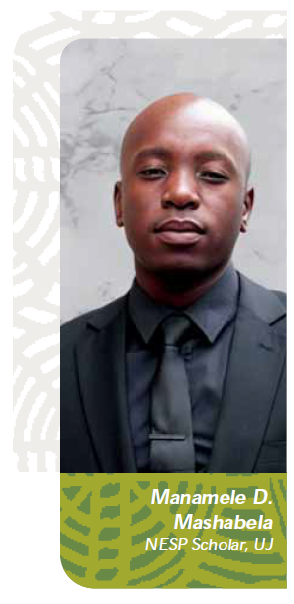
Manamele D. Mashabela
NESP Scholar, UJ
One of the most significant benefits of NESP has been the mentorship I’ve received from experienced and well-established academics such as Prof. Abidemi Kappo and Dr. Msizi Mhlongo, who also served as my MSc (and current PhD) supervisor. This mentorship has not only enhanced my research skills but has also deepened my understanding of academia as a whole, from effective teaching techniques to publishing in high-impact journals. With their guidance, I have been able to contribute to several publications, and secured an opportunity to attend an international conference, the 20th Annual Metabolomics Conference hosted in Osaka, Japan in June of 2024. The financial support from NESP has alleviated personal worries, enabling me to fully focus on my research and academic development.

During my academic internship, I had the experience of lecturing under the supervision of experienced faculty members which provided me with hands-on knowledge that cannot be obtained in the classroom alone, curriculum development, administrative responsibilities and student assessments. The guidance I received throughout the internship year equipped me with the confidence and skills necessary for success as an academic while sparking the desire to learn more and develop myself in this journey.
The NESP scholarship has been the foundation of my academic journey, facilitating milestones that have significantly shaped my career, personal life and my own outlook on life. Through the program, I successfully completed my MSc. and have since secured a threeyear contract as an assistant lecturer. I have also registered for my PhD, marking the next phase of my academic career. The scholarship’s support has enabled me to publish eight (8) papers in high-impact factor peer-reviewed journals, with more currently under review, and several others in progress.
My greatest gratitude goes to Dr. Mmamajaga Angie, Magabane and Ms Meagan Strydom, who have been instrumental in the establishment and smooth operation of this programme at UJ. I would also like to extend my gratitude to Prof. Lizelle Piater, Prof. Abidemi Kappo, Dr. Msizi Mhlongo and the Department of Biochemistry at UJ for all their support, motivation, encouragement and guidance throughout this journey, not forgetting the DHET, NESP and all who have been an integral part of this programme from inception to date.
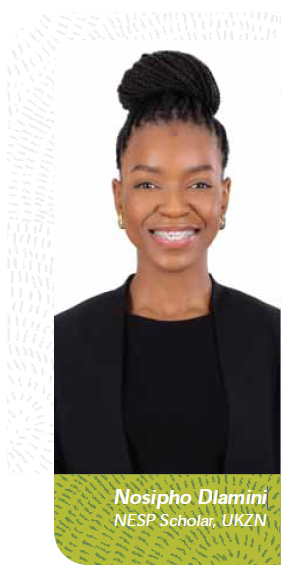
Nosipho Dlamini
NESP Scholar, UKZN
I had the privilege of joining the Phase 1 cohort. My research was a case study approach to “develop integrated climate change adaptation strategies using the Water-Energy-Food (WEF) Nexus approach” at catchment-scale. During the two -year academic phase of the NESP programme, I encountered some challenges. As the programme was new, it wasn’t widely known, and even fewer academic leaders understood its aims and objectives. This made finding a right-fit mentor difficult. However with the support of the NESP team, who were quick to address any concerns I raised, along with the guidance of my supervisors, Dr. Aidan Senzanje and Prof. Tafadzwanashe Mabhaudhi, I was able to overcome this obstacle and successfully complete my MSc(Eng) within time. In addition to finishing my degree, I also published two (2) papers from my research in Q1-rated journals. These milestones that I have achieved through the help of the NESP programme are of greatest significance in my fledgling academic career.
During the one-year NESP internship phase, I gained experience in teaching and had the opportunity to work alongside Dr. Ashiel Jumman and my mentor Prof. Tilahun Seyoum Workneh, in producing teaching and learning material for a 3rd and 4th year engineering module “Soil and Water Conservation Engineering”.
I gained valuable insight into the art of teaching, particularly in breaking down complex scientific terms, processes, and techniques into digestible pieces for young minds. This experience gave me great confidence in the quality of students that the University of KwaZulu-Natal is producing and in the promising future engineers that South Africa is fostering. In addition to teaching, I published a book chapter and the last chapter of my MSc(Eng) thesis. I also had the opportunity to travel to Spain for a three-month exchange program at the University of Valladolid, where I learned System Dynamics Modelling (SDM). Engaging with international students and lecturers was an enriching experience that went beyond acquiring the technical skill of SDM.